

Chicken Road Casino India: Safe Gameplay and RTP Guide

Chicken Road Game Overview Table
The headline facts in one place. Exact figures live in the game’s info panel and can vary between versions, so the panel always wins over any summary.
| Feature | Detail |
| Game type | Crash-style road-crossing, instant rounds |
| RTP | Commonly listed around 98% — confirm in the info panel |
| Volatility | Scales with difficulty, from low to very high |
| Difficulty modes | Easy, Medium, Hard, Hardcore |
| Devices | Mobile and desktop browser; platform apps where offered |
| Modes | Demo with virtual credits and real-money play |
| Core decision | Cash out per step or push for a higher multiplier |
| Round length | Seconds |
Two rows deserve a flag. RTP near 98% sits above many slots, which is part of the title’s appeal — but it is a long-run statistical figure, not a promise about any session. And volatility is a player choice here, set by the difficulty toggle, which is unusual and central to how the game should be approached.
What Is Chicken Road Casino Game

The premise is a joke turned into a wager: why did the chicken cross the road, and how far does it get. A round starts with a stake. The chicken steps across lanes of traffic, and each lane survived multiplies the stake further. The player holds one decision the whole way — keep crossing or take the money. Cash out, and the stake times the current multiplier lands in the balance. Mistime it, and a collision ends the round with the stake gone.
The theme is cartoonish; the structure underneath is pure risk management. There are no bonus wheels, no free-spin layers, no side mechanics to learn — just a rising number and an exit button. That bareness is why the chicken road gold version draws both beginners, who grasp it in one round, and risk-takers, who chase the top multipliers on the harshest setting.
How Chicken Road Works Online

The game runs inside gambling platforms rather than as a standalone product, so playing it online means opening a platform that carries it. The browser route covers phones and desktops alike: open the official site, find the title, and the round loads in the tab — no chicken road download needed, though some platforms offer their own apps through official channels.
A few session habits keep the experience clean:
- Start in the chicken road demo to learn the rhythm before staking anything
- Set the bet size and the exit plan before the round starts, not during it
- Keep sessions short — rounds last seconds, and an hour disappears fast
- Play on a stable connection, since a drop mid-round is the worst possible timing
- Stop at the limit set in advance, win or lose
The pace is the trap and the charm at once. A round resolving in seconds invites the next one immediately, which is exactly why the plan has to exist before the first click.
RTP, Difficulty Levels and Risk
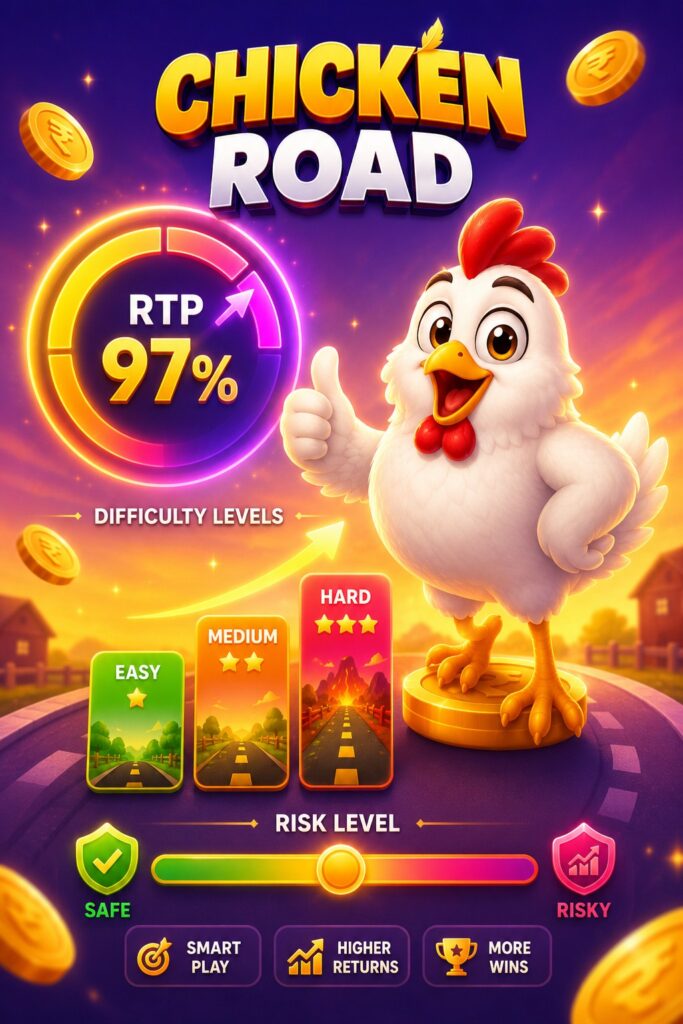
RTP — return to player — is the share of all wagers a game pays back over a very long run. A figure around 98% means that, across millions of rounds, the game returns about 98% of what is staked, keeping roughly 2% as the house edge. What it does not mean: that a player gets 98% of their money back tonight. Short sessions swing far wider in both directions; the percentage describes the ocean, not any single wave.
Difficulty is where the game hands risk control to the player. Each level changes the odds per step and the multiplier curve:
- Easy — most steps succeed; multipliers grow slowly; sessions last longer.
- Medium — the balanced middle; meaningful risk, meaningful reward.
- Hard — failures come quickly; multipliers climb steeply for those who survive.
- Hardcore — the headline mode; most rounds end early, and the rare full crossings pay figures that exist mostly on the paytable.
Higher possible reward always rides with higher risk of losing the stake — the game never breaks that trade, whatever the difficulty label suggests. The honest read of the structure: pick the level that fits the budget’s tolerance for losing streaks, because every level produces them.
Chicken Road Game Real or Fake: How to Check
Clones and rigged copies exist, and they imitate the look well. The checks that separate a real version from a fake are mechanical:
- Verify the platform’s license — a real operator names its regulator and license number, checkable on the regulator’s site
- Confirm the game provider — the title should load with its studio’s branding, matching the provider’s official game list
- Test the demo behavior — a fake often “pays” suspiciously well in demo to bait a deposit
- Read the domain — copied platforms live on lookalike addresses with swapped characters
- Reject seed-phrase requests — no real casino game asks for crypto wallet keys, ever
- Distrust guaranteed-win framing — any version sold with a “trick that always works” is a scam by definition
A real chicken road gold game pays by its published odds and never promises outcomes. A fake exists to take the deposit, the login or both. Five minutes of checking beats any recovery effort afterwards.
Where Can Indian Players Find Chicken Road Casino
The title appears on international platforms that license games from its studio. Rather than chasing names from ads, a player does better verifying any candidate platform directly:
| Check | What to look for |
| License | Regulator and number in the footer, verifiable externally |
| Provider list | The game studio present in the platform’s provider catalogue |
| Demo access | Practice mode available, behaving by the published odds |
| Payments page | Clear deposit and withdrawal terms before registering |
| India terms | The platform’s own rules on accepting players from India |
The India side needs its own line. Gambling regulation in the country sits largely at the state level, several states restrict or ban online betting, and offshore platforms occupy a contested grey area — periodically hit by domain blocks and treated differently from one state to the next. Checking the law in one’s own state belongs on the list above as the first row, not a footnote, and this guide gives no methods for working around any restriction.
Bonuses and Promotions for Chicken Road
Platforms wrap the game in their standard promotions: deposit matches, free-bet credits, cashback on losses, occasional tournaments on crash titles. The mechanics are platform-wide rather than game-specific — and the value of any offer lives in its terms, not its banner.
Before activating anything, the checklist is constant:
- Wagering requirement — how many times the bonus must be played through
- Game eligibility — whether crash titles count toward wagering, and at what weight
- Maximum bet during wagering — exceeding it can void the offer
- Expiry — the window before unused bonus funds vanish
- Withdrawal cap — limits on how much bonus play can pay out
- Regional eligibility — whether the offer applies to players from India at all
A large percentage with hostile terms is worth less than a small offer with clean ones. And no bonus changes the game’s odds — it changes the bookkeeping around them.

Responsible Gaming and India Legal Notes
The legal picture in India is the player’s own homework: state-level rules, outright restrictions in several states, and offshore platforms in a grey zone. Two further constants apply everywhere — these games are for adults only, and tax rules in India have applied a 30% deduction on net winnings from online gaming, regardless of where a platform is licensed.
The responsible-play side is not decoration on a game this fast:
- Decide a budget that can be lost without damage, and keep it separate from essential money
- Set deposit, loss and time limits before playing
- Treat the demo as the default mode for learning and testing
- Never chase losses — the next round owes nothing to the last one
- Use cooling-off or self-exclusion tools, and seek support if control slips
The chicken road gold demo exists precisely so that curiosity costs nothing; real-money rounds should stay entertainment with a fixed price. A player reaching for a chicken road gold apk from an unofficial source, or for a bigger deposit after a losing streak, is in both cases reaching past the safety rail — and the rail is the point.
FAQ
A crash-style casino game where a chicken crosses lanes of traffic, each safe step multiplies the stake, and the player chooses when to cash out before a collision ends the round. It runs inside gambling platforms in demo and real-money modes, with difficulty levels that set the risk profile.
Through a platform that carries the title: open the official site in a mobile or desktop browser, load the game, set a stake and difficulty, and decide each step whether to continue or cash out. No download is required for the browser route, and the demo mode runs on virtual credits for free practice.
RTP is the long-run percentage of wagers a game returns to players — commonly listed around 98% for this title, which is high for casino games. It matters as a fairness benchmark and for comparing games, but it describes millions of rounds, not a session: short-term results swing far wider than the average suggests.
Four settings — Easy, Medium, Hard, Hardcore — trade safety for multiplier size. Easy offers frequent small wins; Hardcore ends most rounds early but advertises the giant figures. Higher difficulty always means a higher chance of losing the stake per step, so the choice is a risk-tolerance decision, not a skill unlock.
Verify the platform’s license against the regulator, confirm the game studio’s branding matches its official catalogue, test that the demo behaves by published odds rather than paying suspiciously well, and read the domain for lookalike tricks. Any version asking for wallet seed phrases or promising guaranteed wins is fake by definition.